Talaparib Talazoparib 1mg Capsules 30's
Manufacturer: EVEREST PHARMACEUTICALS
Salt: TALAZOPARIB 1MG
Category: Anti-Cancer
Price: $350
Availability: In Stock
Talazoparib is a prescription medicine used as a single agent for the treatment of adults with deleterious or suspected deleterious germline BRCA-mutated (gBRCAm), HER2-negative, locally advanced or metastatic breast cancer, and, in combination with enzalutamide, for HRR gene-mutated metastatic castration-resistant prostate cancer (mCRPC).
Talazoparib is a poly (ADP-ribose) polymerase (PARP) inhibitor. It blocks the PARP1 and PARP2 enzymes involved in DNA repair, leading to increased DNA damage, decreased cell proliferation, and cell death, particularly in cancer cells with BRCA or other DNA repair gene mutations.
Talazoparib is particularly relevant in tumors with impaired homologous recombination DNA repair, such as those carrying certain BRCA1 or BRCA2 mutations.
This medicine is taken orally, once daily, with or without food, and treatment continues until disease progression or unacceptable toxicity, as directed by the treating oncologist. Patients are selected for therapy based on an approved companion diagnostic test.
HER2-negative locally advanced or metastatic breast cancer
Talazoparib is indicated for adults with:
Deleterious or suspected deleterious germline BRCA-mutated
HER2-negative
Locally advanced or metastatic breast cancer.
Patients should be selected using an appropriate approved companion diagnostic where applicable.
Metastatic castration-resistant prostate cancer
Talazoparib, in combination with enzalutamide, is indicated for adults with:
HRR gene-mutated metastatic castration-resistant prostate cancer (mCRPC).
The relevant homologous recombination repair gene alteration should be identified using an approved diagnostic test where required.
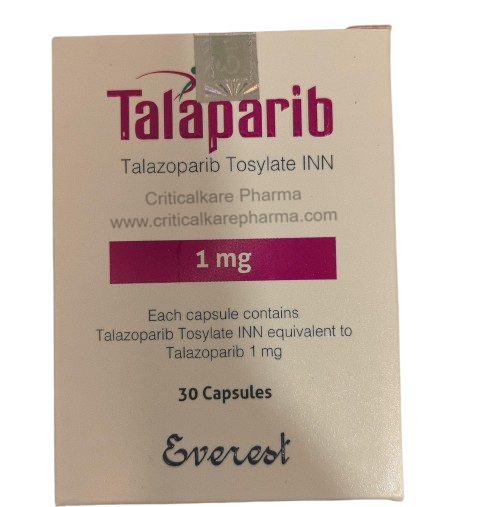
Talaparib Talazoparib 1mg Capsules 30's
Product Information
What is Talaparib Talazoparib 1mg Capsules 30's?
Talazoparib is a prescription medicine used as a single agent for the treatment of adults with deleterious or suspected deleterious germline BRCA-mutated (gBRCAm), HER2-negative, locally advanced or metastatic breast cancer, and, in combination with enzalutamide, for HRR gene-mutated metastatic castration-resistant prostate cancer (mCRPC).
Talazoparib is a poly (ADP-ribose) polymerase (PARP) inhibitor. It blocks the PARP1 and PARP2 enzymes involved in DNA repair, leading to increased DNA damage, decreased cell proliferation, and cell death, particularly in cancer cells with BRCA or other DNA repair gene mutations.
Talazoparib is particularly relevant in tumors with impaired homologous recombination DNA repair, such as those carrying certain BRCA1 or BRCA2 mutations.
This medicine is taken orally, once daily, with or without food, and treatment continues until disease progression or unacceptable toxicity, as directed by the treating oncologist. Patients are selected for therapy based on an approved companion diagnostic test.
Indications for Talaparib Talazoparib 1mg Capsules 30's
HER2-negative locally advanced or metastatic breast cancer
Talazoparib is indicated for adults with:
Deleterious or suspected deleterious germline BRCA-mutated
HER2-negative
Locally advanced or metastatic breast cancer.
Patients should be selected using an appropriate approved companion diagnostic where applicable.
Metastatic castration-resistant prostate cancer
Talazoparib, in combination with enzalutamide, is indicated for adults with:
HRR gene-mutated metastatic castration-resistant prostate cancer (mCRPC).
The relevant homologous recombination repair gene alteration should be identified using an approved diagnostic test where required.
Therapeutic Effects of Talaparib Talazoparib 1mg Capsules 30's
Talazoparib inhibits PARP1 and PARP2 and also traps PARP proteins on DNA.
Normally, PARP participates in repairing single-strand DNA damage.
When PARP is inhibited:
DNA damage → impaired repair → accumulation of DNA damage → cancer-cell death
This effect can be particularly pronounced in cancer cells that already have defects in the homologous recombination repair pathway, including certain BRCA1/BRCA2-mutated tumors.
This concept is sometimes described as synthetic lethality.
In simple terms:
BRCA/HRR-deficient cancer cell + PARP inhibition → inability to adequately repair DNA → cancer-cell death
How to consume Talaparib Talazoparib 1mg Capsules 30's
The usual recommended adult dose is 1 mg orally once daily.
Talazoparib is taken once daily, with or without food.
- Take the capsule at approximately the same time every day.
- Swallow the capsule whole.
- Do not crush, chew, or dissolve the capsule.
- Follow the exact dose prescribed by the oncologist.
Reduced dose
Dose reductions may be required depending on:
- Kidney function
- Blood cell counts
- Adverse reactions
- Concomitant medicines.
Lower capsule strengths, including 0.25 mg, allow dose adjustment when required.
Missed dose
- If a dose is missed or vomiting occurs after taking the medicine, do not take an additional dose to compensate.
- Take the next dose at the regularly scheduled time unless the treating physician provides different instructions.
Side Effects of Talaparib Talazoparib 1mg Capsules 30's
Common:
- Fatigue
- Nausea
- Headache
- Decreased appetite
- Vomiting
- Diarrhea
- Constipation
- Hair loss
- Anemia
- Low platelet count
- Low white blood cell count
- Dizziness
- Abdominal discomfort
The frequency and severity can vary depending on the cancer being treated and whether talazoparib is used alone or with another medicine.
Serious:
Bone marrow suppression
This is one of the most important safety concerns.
Talazoparib can cause significant decreases in:
- Hemoglobin/red blood cells
- White blood cells
- Neutrophils
- Platelets
This can result in:
Anemia → fatigue, weakness, shortness of breath
Neutropenia → increased infection risk
Thrombocytopenia → bruising or bleeding
Complete blood counts should therefore be monitored regularly.
Contact the healthcare team promptly for:
- Fever
- Chills
- Signs of infection
- Unusual bleeding
- Easy bruising
- Severe weakness
- Shortness of breath
Myelodysplastic syndrome / Acute myeloid leukemia
Rare but serious cases of:
- Myelodysplastic syndrome (MDS)
- Acute myeloid leukemia (AML)
have been reported with PARP inhibitors, including talazoparib.
Patients receiving prolonged treatment should be monitored for persistent or unexplained blood-count abnormalities.
Secondary malignancies
Because talazoparib interferes with DNA repair, long-term treatment requires appropriate monitoring for rare secondary hematologic malignancies.
Severe anemia
Anemia can become clinically significant and may require:
- Dose interruption
- Dose reduction
- Blood transfusion
- Additional medical evaluation.
Drug Interactions
Talazoparib has clinically important drug-interaction considerations.
Talazoparib is a substrate of P-glycoprotein (P-gp).
Certain P-gp inhibitors can increase talazoparib exposure and potentially increase toxicity.
Depending on the specific interacting medicine and indication, the physician may need to consider dose adjustment or alternative therapy.
Examples of medicines that may require particular attention include certain:
- P-gp inhibitors
- Cardiovascular medicines
- Anti-infective medicines
Always provide your oncologist/pharmacist with a complete list of medicines and supplements.
Other anticancer medicines
When talazoparib is prescribed together with enzalutamide, the interaction profile of both medicines needs to be considered.
Do not start, stop, or change any medicine without consulting the treating physician.
Storage & Handling
Store talazoparib capsules at 20°C–25°C (68°F–77°F).
Permitted temperature excursions are generally 15°C–30°C (59°F–86°F).
Keep capsules:
- In their original container
- Protected from excessive moisture
- At room temperature
- Out of reach of children.
Do not use capsules that are damaged or expired.
Expert Advice
- Take talazoparib exactly as prescribed.
- Take it once daily at approximately the same time.
- Swallow the capsule whole.
- Do not crush or chew the capsule.
- Attend all scheduled complete blood count (CBC) monitoring.
- Report fever or signs of infection promptly.
- Report unusual bruising or bleeding.
- Tell your doctor if you develop severe fatigue or breathlessness.
- Inform your doctor about all prescription medicines, OTC medicines, and supplements.
- Tell your healthcare team about any previous bone-marrow disorders or blood cancers.
- Do not become pregnant during treatment.
- Discuss contraception with your oncologist before starting treatment.
- Do not breastfeed while receiving talazoparib.
- Do not stop treatment without consulting your oncologist.
Worldwide Shipping & Delivery
We provide specialized tracked delivery for Talaparib Talazoparib 1mg Capsules 30's to multiple countries across the globe. Our logistics network ensures temperature-controlled handling for sensitive oncology medications.
- USA Shipping
- UK Delivery
- UAE & Middle East
- Germany & EU
- Australia
- Canada
Professional Safety Guidelines for Talaparib Talazoparib 1mg Capsules 30's

Pregnancy
UnsafeTalazoparib can cause fetal harm. Pregnancy should be avoided during treatment.

BreastFeeding
UnsafeBreastfeeding is not recommended during treatment and for the recommended period after the final dose.

Liver
Consult your doctorTalazoparib exposure is not substantially altered in mild hepatic impairment. Patients with liver disease should nevertheless inform their oncologist and be monitored appropriately.

Lungs
Consult your doctorReport new or worsening shortness of breath, cough or difficulty breathing. Breathlessness may also result from severe anemia or other treatment-related complications.

Alcohol
Consult your doctorThere is no specific absolute alcohol prohibition, but alcohol may worsen fatigue, dizziness, nausea or dehydration. Discuss alcohol consumption with your treating physician.

Driving
UnsafeFatigue, dizziness or weakness may affect driving. Avoid driving or operating machinery if these symptoms impair alertness.
Kidney
Consult your doctorImportant. Talazoparib is substantially eliminated through the kidneys. Dose adjustment is recommended in patients with moderate or severe renal impairment.