Luciada Adagrasib 200mg Tablets 90's
Manufacturer: LUCIUS PHARMACEUTICALS
Salt: ADAGRASIB 200MG
Category: Anti-Cancer
Price: $550
Availability: In Stock
Adagrasib is an orally administered, targeted anticancer medicine belonging to the RAS GTPase family of inhibitors. It is a selective, irreversible inhibitor of KRAS G12C, a specific mutation in the KRAS gene that can drive uncontrolled cancer-cell growth and survival.
KRAS G12C mutations are found in a proportion of patients with non-small cell lung cancer (NSCLC) and colorectal cancer (CRC). Adagrasib binds irreversibly to the mutant KRAS G12C protein and locks it in an inactive state, thereby inhibiting downstream signaling pathways involved in tumor-cell proliferation and survival.
Adagrasib is currently indicated for adults with KRAS G12C-mutated locally advanced or metastatic NSCLC who have received at least one prior systemic therapy. It is also indicated in combination with cetuximab for adults with KRAS G12C-mutated locally advanced or metastatic colorectal cancer who have previously received fluoropyrimidine-, oxaliplatin-, and irinotecan-based chemotherapy. Patient selection requires confirmation of the KRAS G12C mutation using an FDA-approved test.
The recommended dosage is 600 mg orally twice daily, either as a single agent for the approved NSCLC indication or in combination with cetuximab for the approved CRC indication. Treatment is generally continued until disease progression or unacceptable toxicity.
Adagrasib is supplied as 200 mg tablets for oral administration. Because it can cause important gastrointestinal, cardiac, hepatic, and pulmonary adverse reactions and has several clinically significant drug interactions, treatment should be prescribed and monitored by an appropriately qualified oncology professional.
Non-Small Cell Lung Cancer (NSCLC)
Adagrasib is used as a single-agent treatment for:
- Adults with KRAS G12C-mutated locally advanced or metastatic NSCLC.
- Patients whose disease has progressed or requires treatment after at least one prior systemic therapy.
- The KRAS G12C mutation must be confirmed using an FDA-approved diagnostic test.
Colorectal Cancer (CRC)
Adagrasib is used in combination with cetuximab for:
- Adults with KRAS G12C-mutated locally advanced or metastatic colorectal cancer.
- Patients who have previously received treatment with fluoropyrimidine-, oxaliplatin-, and irinotecan-based chemotherapy.
- KRAS G12C mutation status should be confirmed using an FDA-approved test.
- Precision Cancer Therapy
Adagrasib provides a targeted treatment approach for tumors driven by the KRAS G12C mutation, rather than broadly targeting rapidly dividing cells as conventional chemotherapy does.
Important: The currently approved indications are specific to KRAS G12C-mutated cancers. Adagrasib should not be used simply because a patient has lung or colorectal cancer without confirmation of the appropriate mutation.
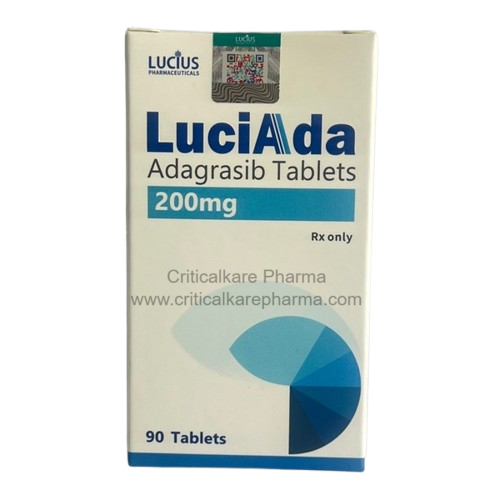
Luciada Adagrasib 200mg Tablets 90's
Product Information
What is Luciada Adagrasib 200mg Tablets 90's?
Adagrasib is an orally administered, targeted anticancer medicine belonging to the RAS GTPase family of inhibitors. It is a selective, irreversible inhibitor of KRAS G12C, a specific mutation in the KRAS gene that can drive uncontrolled cancer-cell growth and survival.
KRAS G12C mutations are found in a proportion of patients with non-small cell lung cancer (NSCLC) and colorectal cancer (CRC). Adagrasib binds irreversibly to the mutant KRAS G12C protein and locks it in an inactive state, thereby inhibiting downstream signaling pathways involved in tumor-cell proliferation and survival.
Adagrasib is currently indicated for adults with KRAS G12C-mutated locally advanced or metastatic NSCLC who have received at least one prior systemic therapy. It is also indicated in combination with cetuximab for adults with KRAS G12C-mutated locally advanced or metastatic colorectal cancer who have previously received fluoropyrimidine-, oxaliplatin-, and irinotecan-based chemotherapy. Patient selection requires confirmation of the KRAS G12C mutation using an FDA-approved test.
The recommended dosage is 600 mg orally twice daily, either as a single agent for the approved NSCLC indication or in combination with cetuximab for the approved CRC indication. Treatment is generally continued until disease progression or unacceptable toxicity.
Adagrasib is supplied as 200 mg tablets for oral administration. Because it can cause important gastrointestinal, cardiac, hepatic, and pulmonary adverse reactions and has several clinically significant drug interactions, treatment should be prescribed and monitored by an appropriately qualified oncology professional.
Indications for Luciada Adagrasib 200mg Tablets 90's
Non-Small Cell Lung Cancer (NSCLC)
Adagrasib is used as a single-agent treatment for:
- Adults with KRAS G12C-mutated locally advanced or metastatic NSCLC.
- Patients whose disease has progressed or requires treatment after at least one prior systemic therapy.
- The KRAS G12C mutation must be confirmed using an FDA-approved diagnostic test.
Colorectal Cancer (CRC)
Adagrasib is used in combination with cetuximab for:
- Adults with KRAS G12C-mutated locally advanced or metastatic colorectal cancer.
- Patients who have previously received treatment with fluoropyrimidine-, oxaliplatin-, and irinotecan-based chemotherapy.
- KRAS G12C mutation status should be confirmed using an FDA-approved test.
- Precision Cancer Therapy
Adagrasib provides a targeted treatment approach for tumors driven by the KRAS G12C mutation, rather than broadly targeting rapidly dividing cells as conventional chemotherapy does.
Important: The currently approved indications are specific to KRAS G12C-mutated cancers. Adagrasib should not be used simply because a patient has lung or colorectal cancer without confirmation of the appropriate mutation.
Therapeutic Effects of Luciada Adagrasib 200mg Tablets 90's
- Selective targeting of KRAS G12C-mutated cancer cells.
- Irreversible inhibition of mutant KRAS G12C signaling.
- Reduction of downstream signaling pathways responsible for cancer-cell proliferation and survival.
- Inhibition of tumor-cell growth and proliferation.
- Reduction in tumor burden in responsive patients.
- Delay of cancer progression in appropriately selected patients.
- Achievement of objective tumor responses in patients with KRAS G12C-mutated NSCLC and CRC.
In colorectal cancer, Adagrasib is administered with cetuximab, which targets the epidermal growth factor receptor (EGFR). The combination provides a complementary approach to suppressing signaling pathways involved in KRAS G12C-driven tumor growth.
Adagrasib is therefore considered a precision oncology therapy, with treatment selection based on the molecular characteristics of the patient's tumor.
How to consume Luciada Adagrasib 200mg Tablets 90's
Adagrasib should be taken exactly as prescribed by the oncologist.
Recommended Dose:
The recommended dosage is 600 mg orally twice daily.
This dosage applies to:
- Adagrasib as a single agent for the approved NSCLC indication.
- Adagrasib in combination with cetuximab for the approved CRC indication.
- Administration
- Take Adagrasib twice daily, approximately 12 hours apart.
- It may be taken with or without food.
- Take the medicine at approximately the same times every day.
- Swallow the tablets whole with water unless your healthcare provider gives different instructions.
- Continue treatment until disease progression or unacceptable toxicity, unless your oncologist instructs you otherwise.
Missed Dose:
- If a dose is missed by more than 4 hours, skip the missed dose and take the next dose at the regularly scheduled time.
- Do not take two doses at the same time to compensate for a missed dose.
Dose Modification:
Your oncologist may:
- Temporarily interrupt treatment.
- Reduce the dosage.
- Permanently discontinue treatment.
This may be necessary if significant adverse reactions develop.
Side Effects of Luciada Adagrasib 200mg Tablets 90's
Common:
- Nausea
- Diarrhea
- Vomiting
- Fatigue
- Musculoskeletal pain
- Decreased appetite
- Swelling (edema)
- Constipation
- Abdominal pain
- Shortness of breath
- Cough
- Dizziness
- Changes in liver enzymes
Gastrointestinal adverse reactions are particularly important during Adagrasib treatment.
Serious:
Contact your healthcare provider urgently if you experience:
- Severe diarrhea or persistent vomiting
- Fainting or significant palpitations
- New breathing difficulties
- Severe chest discomfort
- Yellowing of the skin or eyes
- Severe weakness or unexplained fatigue
- Any rapidly worsening or unusual symptoms
Drug Interactions
Patients should inform their healthcare provider about all prescription medicines, over-the-counter medicines, vitamins, herbal products, and supplements they are taking.
Avoid concomitant use with strong CYP3A4 inducers, because they can reduce adagrasib exposure and potentially decrease its anticancer effectiveness.
Examples include:
- Rifampin
- Carbamazepine
- Phenytoin
- Phenobarbital
- St. John's Wort
Adagrasib may increase concentrations of sensitive CYP3A4 substrates. Avoid concomitant use where increased exposure could result in serious or life-threatening adverse reactions.
Storage & Handling
- Store Adagrasib tablets according to the manufacturer's labeled storage conditions.
- Keep the tablets in their original container.
- Keep the bottle tightly closed.
- The bottle contains a desiccant to protect the medicine from moisture.
- Do not eat or swallow the desiccant.
- Keep the medicine in a dry environment away from excessive heat and moisture.
- Keep Adagrasib out of the reach and sight of children.
- Do not use the medicine after the expiry date printed on the packaging.
- Dispose of unused or expired medicine according to applicable local pharmaceutical-waste disposal requirements.
The precise storage temperature and handling requirements should always be checked against the specific manufacturer's package insert supplied with the product.
Expert Advice
Adagrasib is a precision-targeted KRAS G12C inhibitor that directly targets an important oncogenic driver in selected lung and colorectal cancers. Its effectiveness depends on accurate molecular identification of the KRAS G12C mutation and careful management of gastrointestinal, cardiac, hepatic, pulmonary, and drug-interaction risks. When used in the appropriately selected patient population and under specialist supervision, it provides an important targeted treatment option for advanced KRAS G12C-mutated cancer.
Worldwide Shipping & Delivery
We provide specialized tracked delivery for Luciada Adagrasib 200mg Tablets 90's to multiple countries across the globe. Our logistics network ensures temperature-controlled handling for sensitive oncology medications.
- USA Shipping
- UK Delivery
- UAE & Middle East
- Germany & EU
- Australia
- Canada
Professional Safety Guidelines for Luciada Adagrasib 200mg Tablets 90's

Pregnancy
UnsafeAdagrasib may cause fetal harm based on its mechanism of action and findings from animal studies. Women who could become pregnant should discuss effective contraception with their healthcare provider before starting treatment. If pregnancy occurs during treatment, inform the healthcare provider promptly.

BreastFeeding
UnsafeBreastfeeding should not be undertaken during Adagrasib treatment and for 1 week after the final dose, because of the potential for serious adverse reactions in a breastfed child.

Liver
CautionAdagrasib can cause hepatotoxicity, including elevations in liver enzymes and bilirubin. Liver function should be monitored during treatment. Contact your healthcare provider if you develop: Yellowing of the skin or eyes Dark urine Severe fatigue Persistent nausea or vomiting Abdominal pain

Alcohol
Consult your doctorA specific clinically significant interaction between alcohol and Adagrasib has not been established. However, alcohol may worsen gastrointestinal symptoms such as nausea, vomiting, or diarrhea and may be inappropriate in patients experiencing liver-related adverse effects. Discuss alcohol consumption with your healthcare provider.

Driving
CautionAdagrasib may cause fatigue, dizziness, nausea, or other symptoms that could affect alertness. Patients should avoid driving or operating machinery if these effects impair their ability to do so safely.

Kidney
Consult your doctorPatients with renal impairment should inform their healthcare provider before starting treatment. The oncologist will consider kidney function and the patient's overall clinical condition when determining appropriate treatment and monitoring.