Lucicapiva Capivasertib 200mg Tablets 64's
Manufacturer: LUCIUS PHARMACEUTICALS
Salt: CAPIVASERTIB 200MG
Category: Anti-Cancer
Price: $490
Availability: In Stock
Capivasertib 200 mg tablets contain the active ingredient capivasertib, an oral targeted anticancer medicine belonging to the class of AKT kinase inhibitors.
Capivasertib works by inhibiting AKT, a key protein involved in signaling pathways that regulate cancer cell growth, survival, and proliferation. Abnormal activation of the PI3K/AKT pathway can contribute to the development and progression of cancer. By blocking AKT signaling, capivasertib helps inhibit tumor cell growth.
The 200 mg strength is available as a film-coated tablet. The approved recommended dosage is generally 400 mg twice daily for 4 days, followed by 3 days without treatment, although dosage modifications may be required depending on tolerability and drug interactions.
HR-positive, HER2-negative advanced or metastatic breast cancer
In combination with fulvestrant for adults with hormone receptor (HR)-positive, HER2-negative, locally advanced, or metastatic breast cancer with one or more PIK3CA, AKT1, or PTEN alterations, following progression on at least one endocrine-based regimen in the metastatic setting or recurrence during/within 12 months of completing adjuvant therapy.
PTEN-deficient metastatic prostate cancer
In combination with abiraterone and prednisone for adults with metastatic androgen pathway modulation-naïve or androgen pathway modulation-sensitive prostate cancer that is PTEN-deficient, as identified by an FDA-authorized test. This indication was approved by the FDA in June 2026.
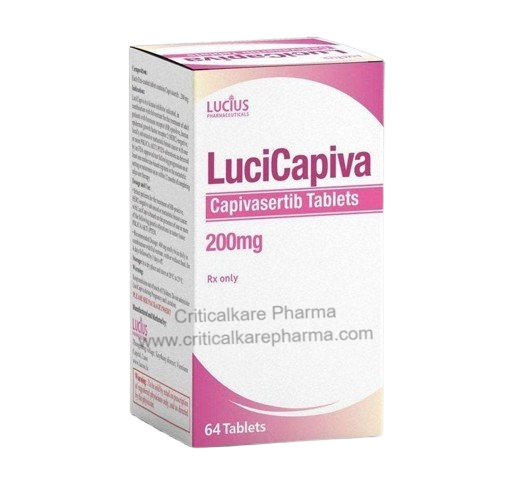
Lucicapiva Capivasertib 200mg Tablets 64's
Product Information
What is Lucicapiva Capivasertib 200mg Tablets 64's?
Capivasertib 200 mg tablets contain the active ingredient capivasertib, an oral targeted anticancer medicine belonging to the class of AKT kinase inhibitors.
Capivasertib works by inhibiting AKT, a key protein involved in signaling pathways that regulate cancer cell growth, survival, and proliferation. Abnormal activation of the PI3K/AKT pathway can contribute to the development and progression of cancer. By blocking AKT signaling, capivasertib helps inhibit tumor cell growth.
The 200 mg strength is available as a film-coated tablet. The approved recommended dosage is generally 400 mg twice daily for 4 days, followed by 3 days without treatment, although dosage modifications may be required depending on tolerability and drug interactions.
Indications for Lucicapiva Capivasertib 200mg Tablets 64's
HR-positive, HER2-negative advanced or metastatic breast cancer
In combination with fulvestrant for adults with hormone receptor (HR)-positive, HER2-negative, locally advanced, or metastatic breast cancer with one or more PIK3CA, AKT1, or PTEN alterations, following progression on at least one endocrine-based regimen in the metastatic setting or recurrence during/within 12 months of completing adjuvant therapy.
PTEN-deficient metastatic prostate cancer
In combination with abiraterone and prednisone for adults with metastatic androgen pathway modulation-naïve or androgen pathway modulation-sensitive prostate cancer that is PTEN-deficient, as identified by an FDA-authorized test. This indication was approved by the FDA in June 2026.
Therapeutic Effects of Lucicapiva Capivasertib 200mg Tablets 64's
Capivasertib is a selective AKT inhibitor.
It works by:
- Inhibiting AKT1, AKT2 and AKT3 signaling.
- Blocking signaling pathways involved in cancer cell growth and survival.
- Reducing proliferation of tumor cells.
- Interfering with abnormal PI3K/AKT pathway activity.
- Helping slow tumor progression in cancers driven by relevant molecular alterations.
For breast cancer, treatment selection is based on the presence of PIK3CA, AKT1, or PTEN alterations. For the newly approved prostate-cancer indication, treatment selection is based on PTEN deficiency.
How to consume Lucicapiva Capivasertib 200mg Tablets 64's
- Capivasertib is taken orally twice daily, approximately 12 hours apart.
- The recommended dose is 400 mg twice daily—equivalent to two 200 mg tablets per dose.
- Take for 4 consecutive days, followed by 3 days off treatment.
- It may be taken with or without food.
- Swallow tablets whole with water.
- Do not crush, chew, or split the tablets.
- Continue treatment as prescribed until disease progression or unacceptable toxicity.
If a dose is missed by 4 hours or less, it may be taken when remembered. If it is more than 4 hours late, the missed dose should be skipped and the next dose taken at the normal time.
If vomiting occurs after taking a dose, do not take an additional dose; take the next dose at its scheduled time.
Side Effects of Lucicapiva Capivasertib 200mg Tablets 64's
Serious:
- Severe hyperglycemia, including diabetic ketoacidosis
- Severe diarrhea and dehydration
- Serious cutaneous adverse reactions
- Severe hypersensitivity, including anaphylactic reactions
- Renal injury
- Pneumonia
- Significant abnormalities in blood cell counts
- Serious infection/sepsis
Capivasertib can cause clinically significant increases in blood glucose, and fasting glucose and HbA1C should be evaluated before treatment and monitored regularly.
Common:
- Diarrhea
- Skin reactions/rash
- Nausea
- Fatigue
- Vomiting
- Stomatitis (mouth sores)
- Decreased appetite
- Headache
- Increased blood glucose
- Decreased lymphocyte count
- Decreased hemoglobin
- Decreased white blood cells
- Increased triglycerides
- Increased creatinine
- Decreased neutrophils
In the CAPItello-291 breast-cancer study, diarrhea occurred in approximately 77%, cutaneous adverse reactions in 56%, fatigue in 38%, nausea in 35%, and vomiting in 21% of patients receiving capivasertib with fulvestrant.
Drug Interactions
Patients should inform their healthcare provider about all prescription medicines, over-the-counter medicines, vitamins, and herbal supplements they are taking.
Capivasertib is metabolized primarily through CYP3A4, making CYP3A interactions clinically important.
Medicines requiring particular attention include:
- Strong CYP3A inhibitors—concomitant use should generally be avoided; if unavoidable, capivasertib dosage reduction and monitoring are required.
- Moderate CYP3A inhibitors—capivasertib dosage reduction is recommended.
- Strong and moderate CYP3A inducers—concomitant use should generally be avoided because they can reduce capivasertib exposure and potentially decrease its effectiveness.
- Capivasertib can also affect the exposure of certain medicines metabolized through CYP3A and other transport/metabolic pathways.
Patients should not start or stop taking medicines without consulting their treating physician.
Grapefruit and grapefruit juice should be avoided during treatment.
Storage & Handling
- Store at 20°C–25°C (68°F–77°F).
- Temperature excursions between 15°C and 30°C (59°F and 86°F) are permitted.
- Keep tablets in the original packaging.
- Protect from excessive heat and moisture.
- If tablets are dispensed outside the original packaging as permitted by the labeling, unused tablets should be discarded after 45 days.
- Keep out of reach of children.
Expert Advice
- Monitor fasting blood glucose and HbA1C regularly, particularly because significant hyperglycemia can occur.
- Report excessive thirst, frequent urination, blurred vision, confusion, difficulty breathing, or unexplained weight loss promptly.
- At the first sign of significant diarrhea, maintain adequate fluid intake and contact your healthcare provider regarding appropriate antidiarrheal treatment.
- Report new or worsening skin rash, peeling, blistering, or other serious skin reactions immediately.
- Avoid grapefruit and grapefruit juice during treatment.
- Inform your physician about all medicines and supplements because capivasertib has important CYP3A drug interactions.
- Follow the 4-days-on/3-days-off dosing schedule exactly.
- Regular blood tests may be required to monitor glucose, blood counts, liver function, kidney function, and other laboratory parameters.
- Do not alter or discontinue treatment without consulting your oncologist.
- For breast cancer, appropriate molecular testing for PIK3CA/AKT1/PTEN alterations is important before treatment.
- For PTEN-deficient metastatic prostate cancer, appropriate PTEN testing is required to identify eligible patients.
Worldwide Shipping & Delivery
We provide specialized tracked delivery for Lucicapiva Capivasertib 200mg Tablets 64's to multiple countries across the globe. Our logistics network ensures temperature-controlled handling for sensitive oncology medications.
- USA Shipping
- UK Delivery
- UAE & Middle East
- Germany & EU
- Australia
- Canada
Professional Safety Guidelines for Lucicapiva Capivasertib 200mg Tablets 64's

Pregnancy
UnsafeCapivasertib can cause fetal harm based on its mechanism of action and animal reproductive studies. Females of reproductive potential should use effective contraception during treatment and for 1 month after the last dose. Male patients with female partners of reproductive potential should use effective contraception during treatment and for 4 months after the last dose.

BreastFeeding
UnsafeBreastfeeding is not recommended during treatment with capivasertib. Patients should discuss breastfeeding plans with their physician before starting treatment.
Liver
Consult your doctorPatients with liver impairment should inform their healthcare provider before starting treatment. Mild hepatic impairment did not produce clinically significant pharmacokinetic differences, while the effect of moderate hepatic impairment is not fully characterized. Severe hepatic impairment has not been adequately studied.

Lungs
Consult your doctorPatients should promptly report new or worsening respiratory symptoms such as: Shortness of breath Persistent cough Chest discomfort Difficulty breathing Pneumonia has been reported as a serious adverse reaction in clinical studies.

Alcohol
Consult your doctorThere is no specific major alcohol interaction highlighted in the prescribing information. However, alcohol may worsen treatment-related diarrhea, nausea, fatigue, dizziness, or dehydration. Patients should discuss alcohol consumption with their treating physician.

Driving
CautionCapivasertib may cause fatigue, dizziness, nausea, or other effects that could affect alertness. Patients should avoid driving or operating machinery if they experience symptoms that impair their ability to do so safely.
Kidney
Consult your doctorPatients with kidney disease should inform their healthcare provider. No clinically significant pharmacokinetic differences were observed in patients with mild-to-moderate renal impairment, but severe renal impairment has not been adequately studied. Renal injury and increased creatinine have been reported during treatment.